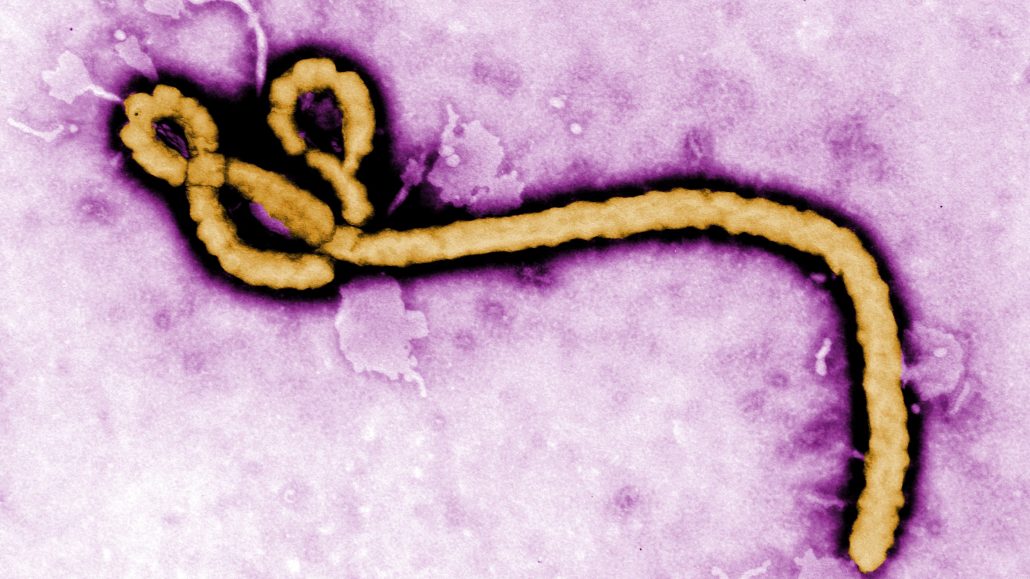
This colorized transmission electron micrograph (TEM) revealed some of the ultrastructural morphology displayed by an Ebola virus virion. See PHIL 1181 for a black and white version of this image.
What is Ebola hemorrhagic fever (Ebola HF)?
Ebola hemorrhagic fever (Ebola HF) is a severe, often-fatal disease in humans and nonhuman primates (monkeys, gorillas, and chimpanzees) that has appeared sporadically since its initial recognition in 1976.
The disease is caused by infection with Ebola virus, named after a river in the Democratic Republic of the Congo (formerly Zaire) in Africa, where it was first recognized. The virus is one of two members of a family of RNA viruses called the Filoviridae. There are four identified subtypes of Ebola virus. Three of the four have caused disease in humans: Ebola-Zaire, Ebola-Sudan, and Ebola-Ivory Coast. The fourth, Ebola-Reston, has caused disease in nonhuman primates, but not in humans.
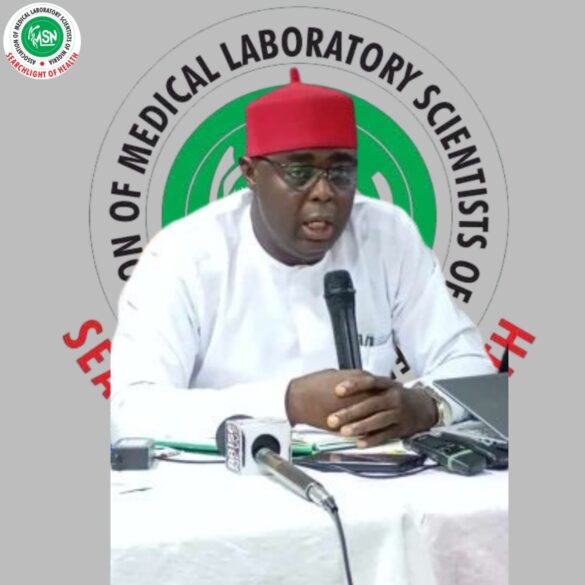
The National President of the Association of Medical Laboratory Scientists of Nigeria (AMLSN), Dr. Ifeanyi Casmir, has warned that the current Ebola outbreak in parts of Central Africa could become one of the most dangerous in recent years if urgent measures are not taken to strengthen disease surveillance, laboratory systems and emergency response mechanisms across the continent.
Speaking exclusively to The Nation on growing concerns surrounding the outbreak, Casmir said the major threat is not that the Ebola virus has become more deadly, but that many of the systems designed to detect and stop outbreaks early have become weaker.
According to him, years of progress made after the devastating 2014-2016 Ebola epidemic in West Africa are gradually being eroded by funding cuts, weakened health systems, insecurity, population displacement and declining public trust in health authorities.
“Ebola remains one of the world’s most dangerous infectious diseases. What worries many public health experts today is not necessarily the virus itself but the fact that some of our key lines of defence are becoming weaker. When surveillance systems are weakened, outbreaks can spread unnoticed and become much harder to control,” he said.
The AMLSN president recalled that after the West African Ebola epidemic, which claimed more than 11,000 lives and infected tens of thousands of people, governments and international partners invested heavily in disease surveillance, laboratory networks, emergency response teams and community health programmes.
Those investments, he noted, helped several African countries improve their ability to detect and respond to disease outbreaks quickly.
However, he said recent reductions in international health funding have begun to threaten those gains.
“Many surveillance programmes that once monitored unusual disease patterns are facing challenges. Some laboratories that relied on donor support are struggling with shortages of equipment and resources. Disease detectives and outbreak investigators trained over the years are no longer available in the numbers required.
“When these systems weaken, the time between the emergence of a disease and the response needed to contain it becomes longer. With Ebola, every day matters. Delays can turn a small outbreak into a major public health emergency,” Casmir said.
He explained that one of the biggest concerns surrounding the current outbreak is the possibility that infections may go undetected for extended periods because the disease often presents symptoms similar to other common illnesses.
According to him, Ebola symptoms in the early stages can resemble malaria, typhoid fever and other febrile illnesses that are common in many African countries.
“This makes laboratory diagnosis extremely important. Without strong laboratory networks and effective disease surveillance systems, cases can easily be mistaken for other illnesses. By the time Ebola is confirmed, infected individuals may have unknowingly transmitted the virus to family members, healthcare workers and others in the community,” he said.
Casmir further noted that many Ebola outbreaks occur in regions already affected by insecurity, armed conflict and political instability, creating additional challenges for health authorities.
He said conflict zones often make it difficult for health workers to access affected communities, carry out contact tracing, administer vaccines and provide treatment.
“In areas affected by violence, people are often displaced from their homes and forced to live in crowded settlements. Such conditions make it easier for infectious diseases to spread. Health facilities may be inaccessible, understaffed or poorly equipped.
Roads may be unsafe, and response teams sometimes require security escorts before they can enter affected communities.
“All these factors slow down outbreak response efforts and give the virus more time to spread,” he explained.
The AMLSN president also identified declining public trust as another major challenge in the fight against Ebola.
He said previous outbreaks have shown that community cooperation is essential for successful disease control efforts.
According to him, misinformation and
rumours continue to undermine public health interventions in many parts of Africa.
“Ebola cannot be controlled through medicine alone. Public trust is critical. Communities must trust health workers, laboratories and government authorities.
“When people refuse testing, hide sick relatives or avoid treatment centres because of fear and misinformation, it becomes much more difficult to stop transmission. In some cases, traditional burial practices can also increase the risk of spreading the disease if proper precautions are not followed,” he said.
Casmir expressed concern that global attention has increasingly shifted to other pressing challenges, including economic crises, conflicts and climate-related disasters, resulting in reduced focus on epidemic preparedness.
He warned that waiting for Ebola outbreaks to become international threats before mobilising resources could have devastating consequences.
“The most cost-effective strategy is always prevention and early detection. It is far cheaper and safer to stop an outbreak at its source than to respond after it has spread across regions and countries.
“Unfortunately, there is a growing tendency globally to react after outbreaks have expanded instead of investing adequately in prevention,” he said.
The AMLSN president also highlighted the growing link between environmental changes and emerging infectious diseases.
He explained that climate change, deforestation and habitat destruction are increasing interactions between humans and wildlife, thereby creating more opportunities for diseases to cross from animals to humans.
“Ebola is believed to originate from wildlife reservoirs, particularly certain species of bats.
As forests are degraded and human activities expand into wildlife habitats, the risk of exposure to disease-carrying animals increases.
“Climate change may not directly cause Ebola outbreaks, but it can create conditions that make disease emergence more likely. This is why environmental protection should also be viewed as a public health issue,” he stated.
Reflecting on Nigeria’s successful containment of Ebola in 2014, Casmir said the country demonstrated that rapid response, strong laboratory support and effective contact tracing can stop even the most dangerous outbreaks.
He recalled that health authorities, laboratory scientists, epidemiologists and other healthcare professionals worked together to prevent what could have become a national catastrophe after the virus was imported into the country.
“Nigeria’s response to Ebola remains one of Africa’s greatest public health success stories. Through coordinated action, aggressive contact tracing, laboratory confirmation of cases and strong government leadership, the outbreak was contained before it could spread widely.
“However, we must not become complacent. Nigeria’s large population, busy airports, extensive land borders and high level of movement mean we must remain vigilant at all times,” he said.
Casmir stressed that infectious diseases do not respect national boundaries and that weaknesses in disease surveillance systems anywhere in Africa could pose risks to countries across the continent.
He therefore called on governments, development partners and public health institutions to recommit themselves to strengthening laboratories, surveillance systems, emergency response structures and community health programmes.
“The lesson from previous Ebola outbreaks is very clear: preparedness saves lives. Investments in laboratory capacity, disease surveillance, outbreak response teams and public health education are not luxuries; they are necessities.
“The current outbreak should serve as a warning to governments and the international community. If health systems continue to weaken, Ebola may become the first major sign of broader vulnerabilities that could expose the world to future epidemics and pandemics.
“The question is no longer whether another outbreak will occur. The question is whether we will be prepared when it happens,” he said.